Dragged-Plane Chalk — Hofmann's colour blocks drawn over in crayon

Hans Hofmann built paintings out of flat slabs of colour pushed hard against each other, so that some seem to jump forward and others fall back. Beatrice Alemagna draws children's books in crayon and chalk, with loose, scratchy hatching that never quite closes a line. Dragged-Plane Chalk puts her drawing on top of his blocks, and keeps the whole thing to four colours: turquoise, cadmium yellow, cadmium red and white.
The blend
- Hans Hofmann — the structure. Abutting colour planes create push-pull depth through dry-brush drags and ragged, uneven edges where planes meet. The picture is built from blocks, not drawn, and the edges where two blocks meet are dragged and rough rather than clean.
- Beatrice Alemagna — the drawing. Crayon-like drawing produces scumbled, hatched tonal variation and broken contours via loosely layered chalky strokes. This is where the figure and the shading come from: hatched, chalky marks over the colour.
- Oil on toothy canvas — the surface. The thin oil layer infuses translucent streaks that let canvas tooth and underlayers show through. Thin paint on rough canvas, so the weave and the earlier layers show through.
The two artists rhyme from opposite ends. Hofmann gives the painting its weight and Alemagna gives it its lightness, and the four-colour palette is what stops the result from turning into mud.
On four models

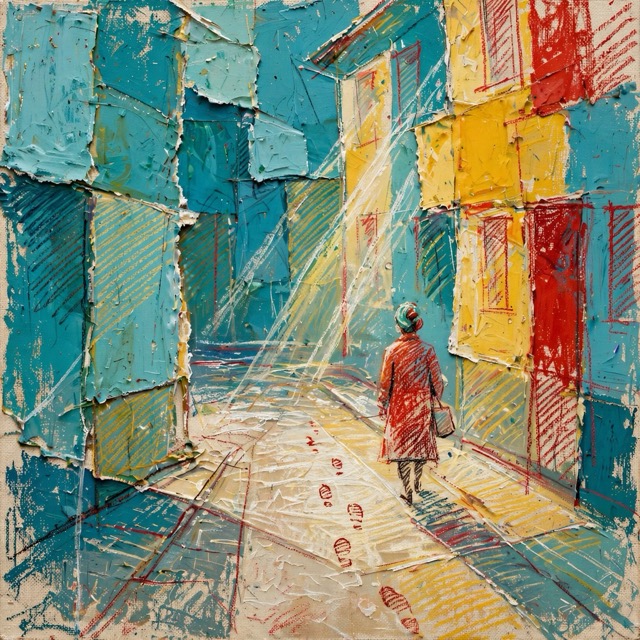


These four were rendered on the collection's subject with a few words added, "woman alone, walking away", so every model would keep a figure in the street.
- Flux 1.1 Pro made the boldest blocks: whole walls of orange, yellow and turquoise, with a small dark figure. It's the most Hofmann and the least Alemagna; the crayon hatching barely shows.
- GPT Image 2 went soft and smudged, with scraped turquoise and yellow patches and a woman in red sketched in pencil over them. It's the closest to a real oil sketch.
- Muse 1.0 took "planes" literally and built the street from torn, overlapping slabs of thick paint, with red crayon hatching across them and footprints on the road.
- Nano Banana 2.1 is the most Alemagna of the four: a street drawn almost entirely in hatched crayon over the four colours, with the figure in a red coat.
Using it
The palette does a lot of the work, so the style suits simple subjects with big shapes: a street, a room, a figure against a wall. Asking for one red thing usually gets it.
If you want more of the crayon, Nano Banana and Muse give you the most. If you want the colour blocks, use Flux.
Both artists are named in the prompt. The style page also has a model-neutral version, which swaps their names for "push-pull colour painting" and "crayon-and-chalk picture-book illustration", and an effect-only version with the recipe taken out.