Scraped-Glaze Slash — Jeremy Mann's scraped streets cut with Fechin's slashing strokes
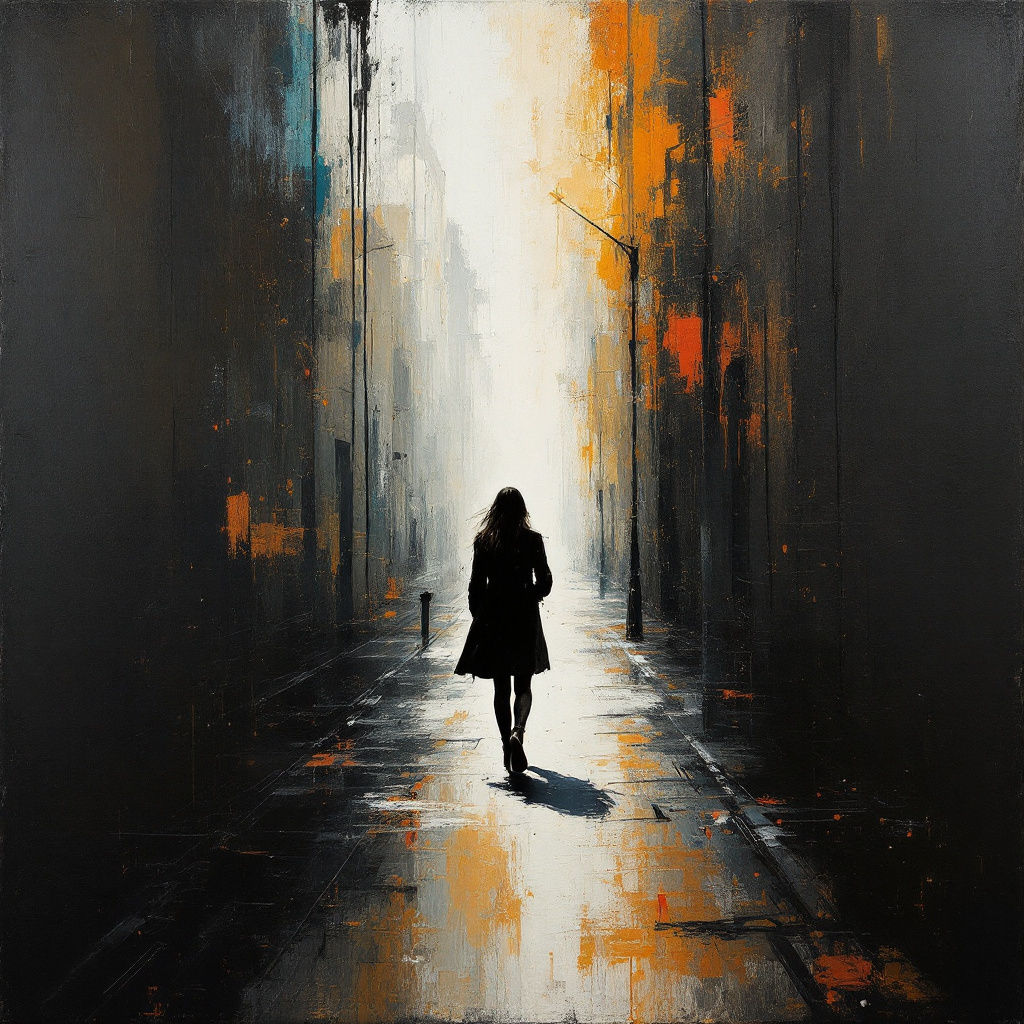
Jeremy Mann paints city streets by laying down dark, see-through glazes and then scraping back into them with a knife, so the surface looks worn and scratched. Nicolai Fechin painted portraits whose edges fall apart into wide, slashing strokes, while the face at the centre is carefully finished. Scraped-Glaze Slash puts the two together on a gessoed panel: rough and broken everywhere except one place, where the painting slows down and gets smooth.
The blend
- Jeremy Mann — the surface. Scraped layering creates an abraded surface of dark translucent glazes through dragged knife edges and incised vertical hairlines. This gives the dark ground and the scratched-through look, including the thin vertical lines cut into the paint.
- Nicolai Fechin — the edges. Slashing broad strokes produce loosely abstracted peripheries via lost-and-found edges. Away from the centre of interest, things dissolve into big strokes, and edges come and go instead of being outlined.
- Oil on gessoed panel — the texture. The panel's tooth infuses ridged impasto that catches light. A hard, slightly rough board, so the thick paint stands up in ridges that pick up highlights.
Both painters work the same way: rough almost everywhere, finished in one spot. That's what the last line of the prompt asks for, "smooth blended modelling confined to one focal passage", and it's why they belong together. Mann adds the dark, scraped city, and Fechin adds the energy at the edges. The palette is burnt umber, ochre, vermilion and teal: warm earth colours with one cool accent.
On four models
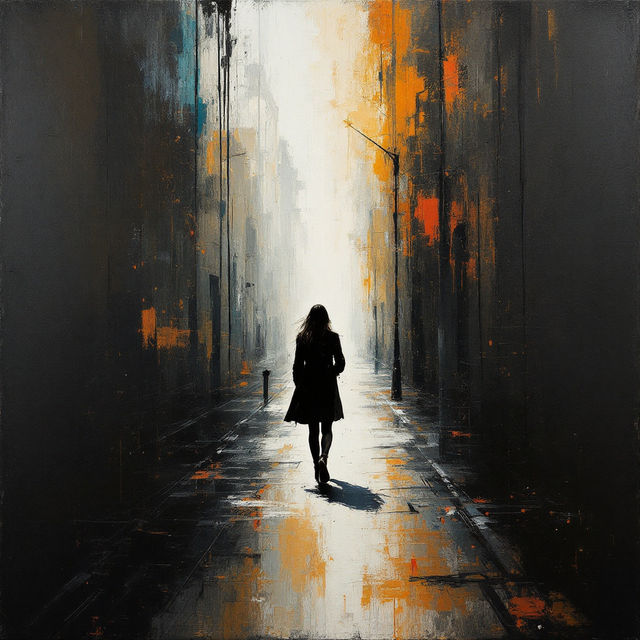
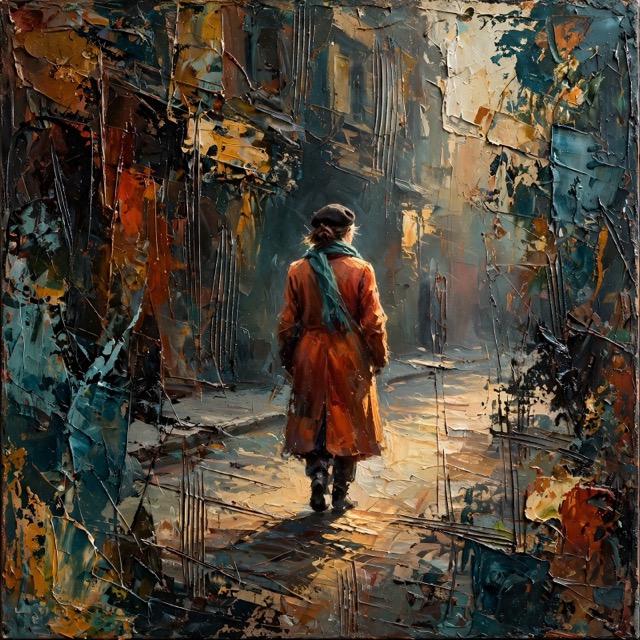
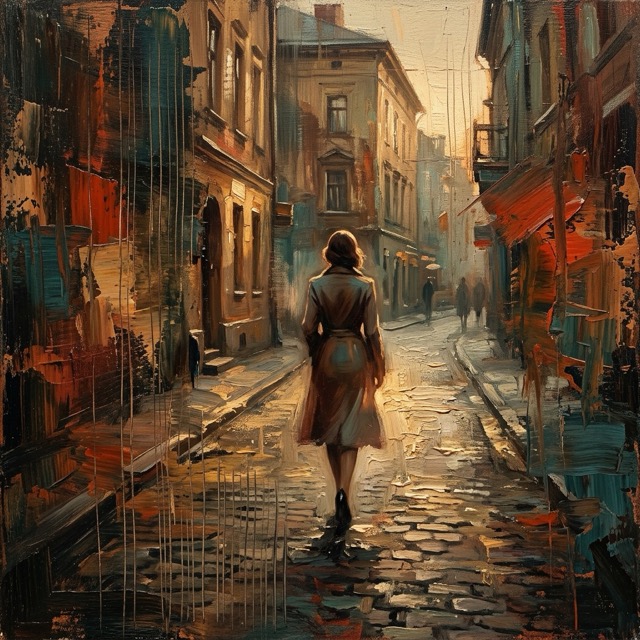

The original Flux render was made with the subject "woman walking away". The other three used the collection's haiku plus "woman alone, walking away", the same nudge #730 used, so every model would keep a figure in the street.
- Flux 1.1 Pro made the darkest and most Mann-like version: a tall, near-black street, scraped streaks of orange and teal on the walls, light at the far end, and a small silhouette on wet paving. The figure is barely modelled at all. It has more of the scraping than the "finish in one spot".
- GPT Image 2 has the clearest centre of interest. The woman's black top and red skirt are painted carefully, and the street around her breaks up into knife-laid patches of ochre, rust and teal. It's the closest to Fechin's way of finishing one area and letting the rest go.
- Muse 1.0 took "incised vertical hairlines" the most literally. Scratched lines run all over the picture, the knife slabs are thick, and a figure in an orange coat and teal scarf walks through it. It's the most textured of the four.
- Nano Banana 2.1 made the most readable street: a cobbled lane between old buildings, with vertical drips and scrapes of red and teal over the left side. It's the gentlest version, and the most like a real Jeremy Mann cityscape.
Using it
It suits subjects with one obvious place to look: a figure in a street, a face, a lit window in a dark room. Without that, the "one focal passage" has nowhere to go and you get all scraping and no finish.
For the darkest, most scraped look use Flux. For a clear figure in a rough setting, use GPT. The canonical image here was rendered on a plain "woman walking away", with no poem, so that's what to use if a model starts writing the haiku into the picture.
Both painters are named in the prompt. The style page also has a model-neutral version, which swaps their names for "scraped atmospheric urban realism" and "slashing Russian-émigré bravura portraiture", and an effect-only version with the recipe taken out.