Splashed Malachite Ink — Zhang Daqian's poured colour, Xu Beihong's loaded stroke, and raw xuan paper
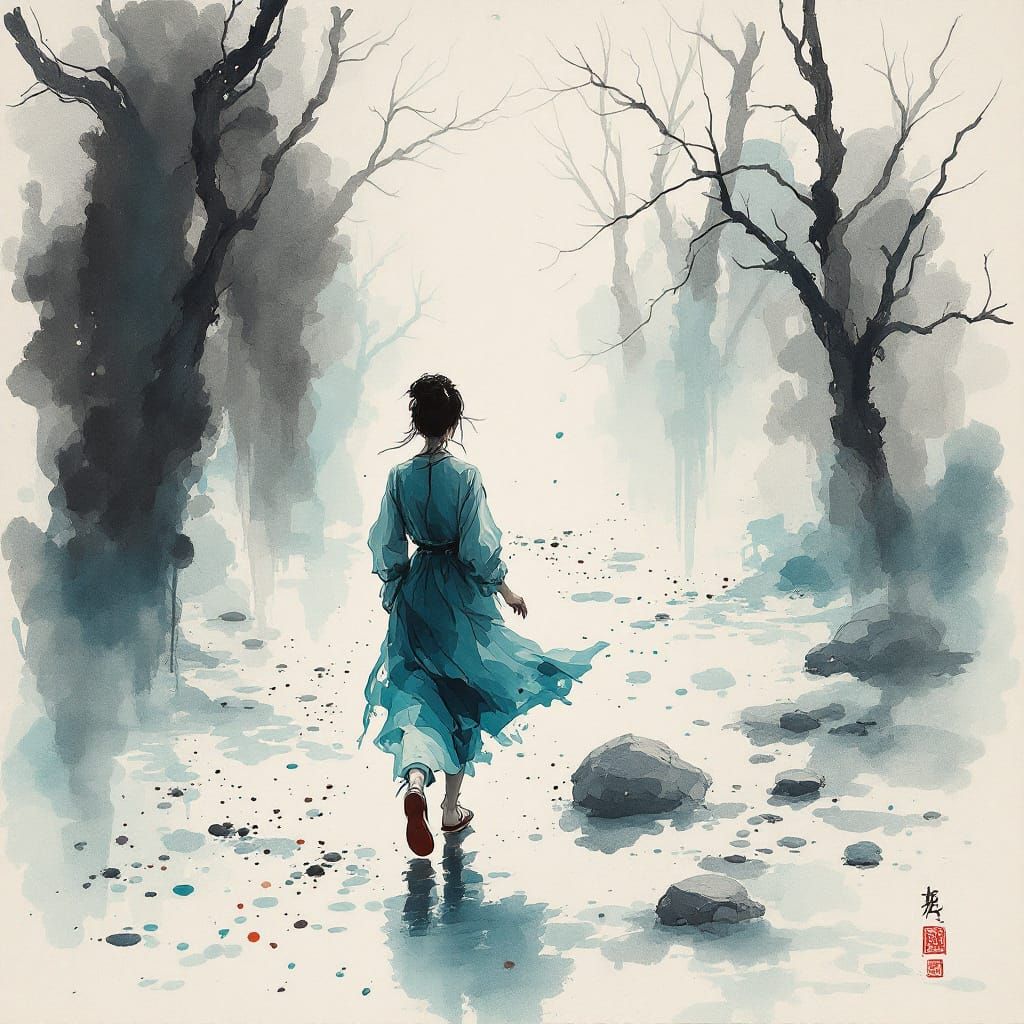
A few heavy strokes of black ink, pools of mineral colour soaking into raw paper, and a lot of nothing. Malachite green, azurite blue and a fleck or two of cinnabar red bleed wet-into-wet into soft clouds, the brush runs dry at the end of each stroke, and the bare paper is left to be the light. Fine line only turns up where something small needs it. It's Chinese ink painting at its most economical: say as much as possible with as few marks as you can.
The blend
- Zhang Daqian — the colour. Splashed-colour technique creates pooled washes of malachite, azurite and cinnabar bleeding wet-into-wet into soft gradients. Zhang's late splashed-colour work poured and tilted mineral pigment across the sheet and let it find its own shape, so the colour arrives as weather rather than as fills.
- Xu Beihong — the stroke. Calligraphic brushwork produces volume from a few loaded strokes of dense carbon ink with dry-brush streaks at trailing edges. Xu could build a galloping horse out of a handful of strokes. What he brings here is that discipline: one loaded brush makes a form, and it breaks into dry streaks as the ink runs out.
- Ink and mineral pigment on raw xuan paper — the surface. The absorbent paper infuses feathered edges and fibrous grain. Unsized paper drinks every mark the moment it lands, so nothing has a hard edge and nothing can be corrected.
The two painters pull in opposite directions, and that's the point. Zhang's colour is loose and accidental; Xu's black is deliberate and placed. The prompt lets the colour spread and keeps the ink sparing, and the closing line, bare paper left as light, stops the whole thing from filling in.
It's the second style in the collection to borrow Zhang's splashed colour. #696 Tidemark Gouache Dropout pushes it into hard tide-line edges and Art Deco stencilling. This one keeps it where it came from, on soft paper next to ink. Its nearest neighbour by look is #475 Stained Translucent Reverie, which also has a walker between bare trees on a wet path, but that's warm Western watercolour, amber and teal filling the page. This one is cooler, emptier and inked.
On four models
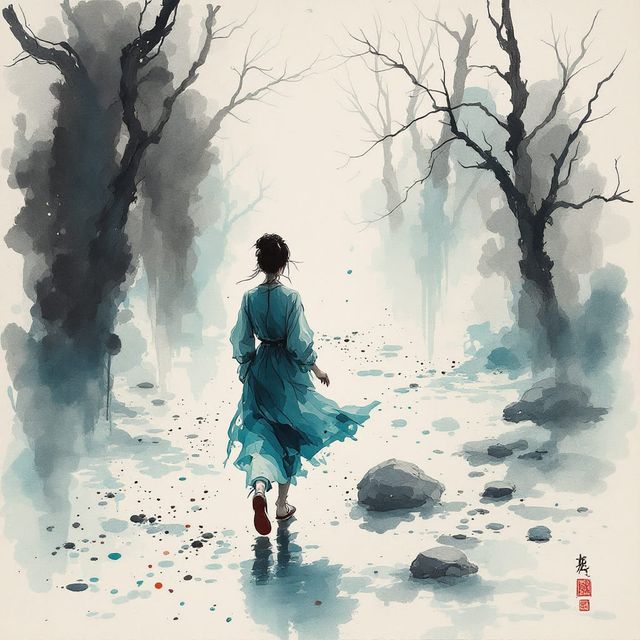
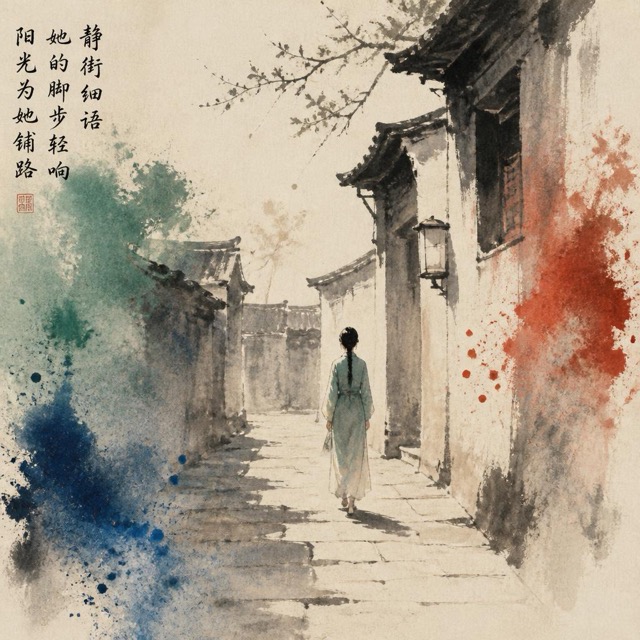
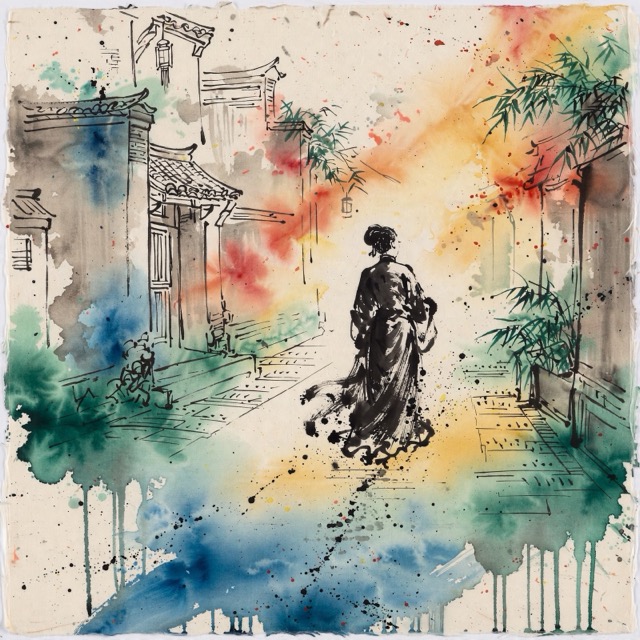
The other three models got the plain original prompt, artist names and all, with the collection's usual haiku as the subject. Flux needed a nudge: its first try lost the subject entirely and came back as pure abstract pattern, just washes and flecks with no figure or street, so the canonical was re-rolled with "woman walks away" added after the haiku. That's subject steering, not style, so it isn't part of the prompt above.
- Flux (the canonical) is the most Xu: bare carbon-ink trees, a figure in a single teal wash walking a wet path, flecks of colour scattered across the ground and a red seal in the corner. Almost everything else is empty paper.
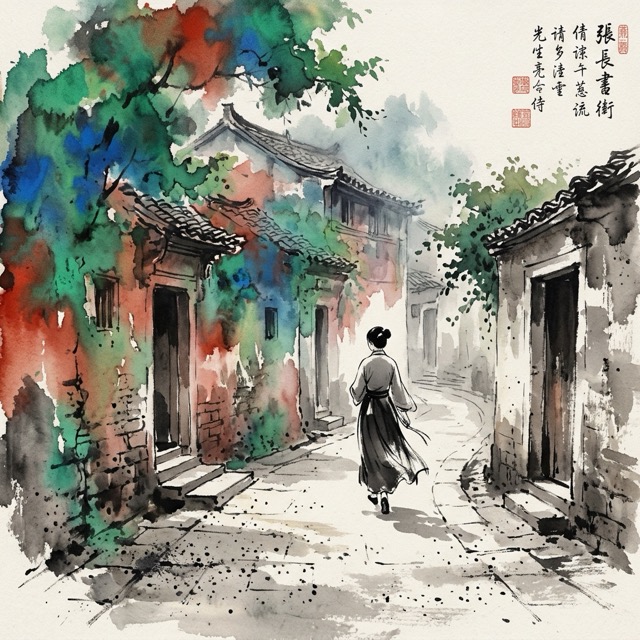
- GPT Image 2 went to a quiet hutong lane with a lantern and tiled roofs. The splashed colour sits at the edges, green and blue on one side and cinnabar on the other, and the figure is barely more than a wash. It also wrote the haiku, translated into Chinese, as an inscription in the top corner. That's the poem being lettered, but in a Chinese ink painting an inscription belongs, so it stays.
- Muse 1.0 is the most Zhang: colour poured right across the sheet in green, blue, yellow and red, running into drips at the bottom, with the figure drawn entirely in loose black ink and spatter.
- Nano Banana 2.1 paints the walls themselves in malachite and cinnabar and adds a column of calligraphy with two seals. It's the most finished of the four and the most like a traditional painting.
Using it
It suits anything with space around it: a single figure, a path, a bird on a branch, mountains in mist. A busy scene fights it, because the style wants most of the paper empty. Be plain about the subject, though: the prompt is so much about marks and paper that Flux happily paints only those, so name the figure directly. Hosted models drew it fine from the original prompt here. If one balks at the names, the model-neutral version swaps them for "Chinese splashed-colour painting" and "modern Chinese academic ink painting", and the effect-only version describes just the pooled washes, the loaded stroke and the paper. If a model writes the subject into the picture and you don't want it, give it a literal subject instead of the haiku.
Tags: Painterly · Ink Wash Painting · Mineral Pigment · Wet-on-Wet · Calligraphic Brushwork · Drybrush · Ink Splatter · Negative Space